Back to Work
AI & Automation

Customiser AI App Design & Frontend Development

Designed and built a modern manufacturing automation platform that eliminates hours of manual document processing through AI-powered BOM extraction, drawing comparison, and intelligent document analysis

Company Customiser AI
Year Ongoing (2025–Present)
Services UI/UX Design, TypeScript Development, API Integration
Duration Ongoing
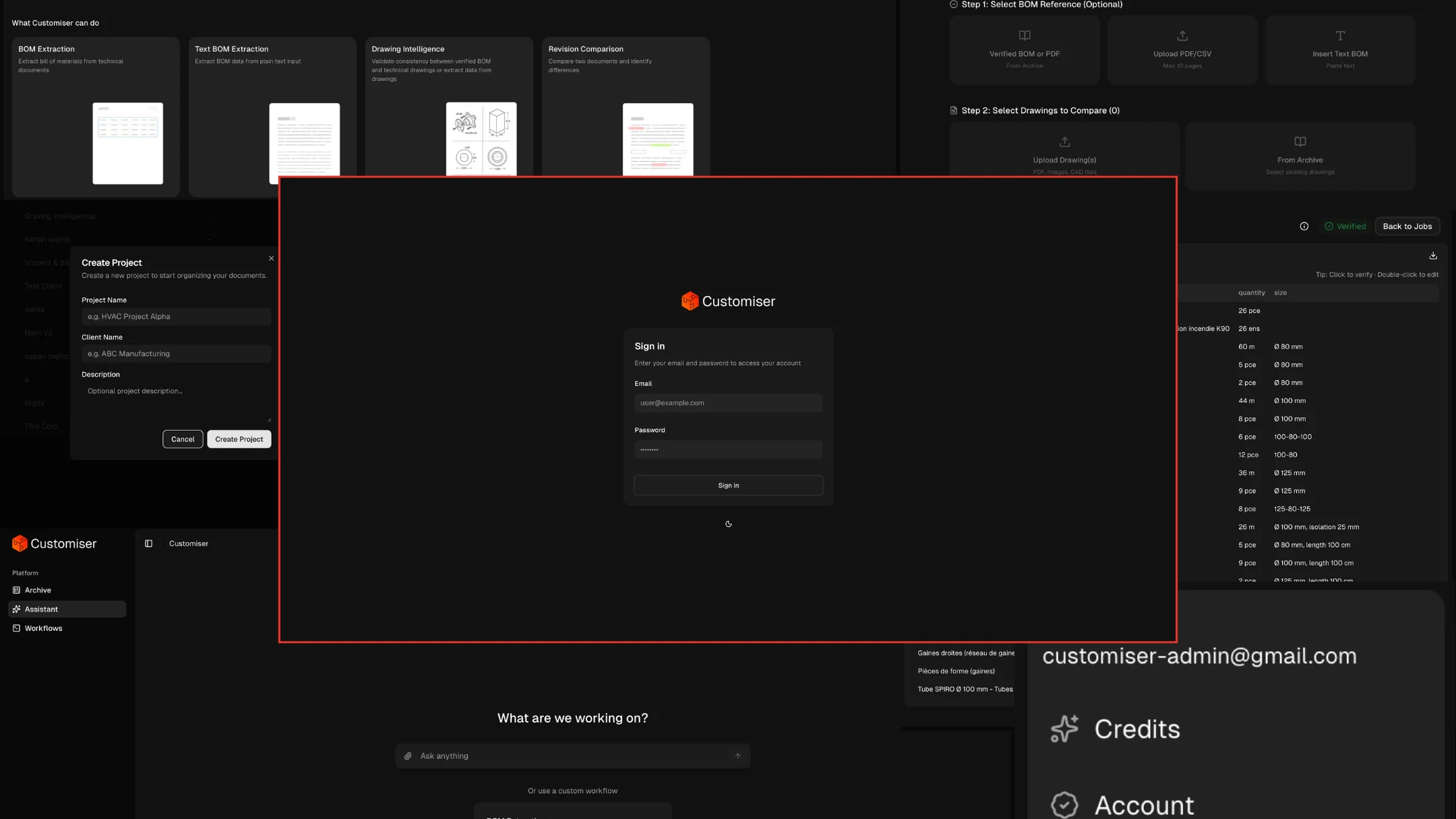
Customiser AI App Hero Image

The Challenge

Manufacturing companies waste countless hours on tedious document processing tasks: manually extracting Bill of Materials (BOM) from technical drawings, comparing drawings to BOMs to catch discrepancies, analyzing supplier quotes across multiple documents, and tracking revision changes between document versions. Engineers spend days doing work that should take minutes. These manual processes are error-prone, time-consuming, and prevent manufacturers from focusing on what actually matters—building products. The industry desperately needs intelligent automation, but existing manufacturing software is clunky, outdated, and feels like it was designed in 2005.

Our Role

We serve as Chief Product Officer and lead the entire product design and frontend development. Our team handles the complete user experience strategy, TypeScript frontend development, and product leadership—deciding what to build and how to build it. We manage all API integration connecting the frontend to our AI backend and own the full product vision.

The Approach

Our core strategy as CPO was user experience obsession in an industry that typically tolerates terrible software. Manufacturing is conservative and old-school—if the UX isn't immediately intuitive, users will reject it regardless of how powerful the AI is. We prioritized simplicity, visual clarity, and workflows that mirror how manufacturing engineers actually think. The app needed to feel modern, fast, and effortless—more like consumer software than enterprise bloatware.

Discovery & Research

As CPO, we conducted extensive research to identify where manufacturers actually lose time. We interviewed production managers, engineers, and procurement specialists to understand their daily pain points. The insights were clear: hours wasted manually transcribing BOMs from PDFs into spreadsheets, mistakes happening when drawings don't match BOMs, and endless back-and-forth comparing supplier quotes across different document formats. We mapped out these workflows in detail, identifying exactly which tasks could be automated and which required human verification. The key finding: manufacturers need AI to do the heavy lifting, but they need full transparency to verify the output—trust but verify.

Design & Development

We designed the UX around three core workflows: BOM extraction, drawing intelligence (comparing drawings to BOMs), and document comparison. For BOM extraction, we built a split-screen interface with the source PDF on the left and the extracted CSV table on the right—with click-to-highlight functionality showing exactly where each data point came from. For drawing intelligence, users see all input drawings on one side, the BOM on the other, with markdown summaries for overall analysis and per-drawing details. The interface highlights matches, mismatches, and missing items in a visual table with text summaries. For document comparison, we show side-by-side views with intelligent diffing. Every workflow includes job detail pages where users can verify AI outputs with full transparency. The design language is minimalistic, modern, and feels like 2026—clean interfaces, subtle animations, intuitive navigation. We built the entire frontend in TypeScript with performance optimization and real-time API integration to our AI backend.

Final Design

The final platform delivers a modern, minimalistic interface that feels nothing like traditional manufacturing software. Users can extract BOMs from technical drawings in seconds with full verification transparency, compare drawings to BOMs to catch discrepancies instantly, and analyze supplier documents or revisions side-by-side with intelligent highlighting. Every workflow is designed for immediate intuitiveness—no training required, no outdated UI patterns, just clean, fast, modern software that does the job perfectly.

Results & Outcomes

The platform successfully automates manual document processing tasks that previously consumed hours of engineering time. Manufacturing teams can now process technical documents in seconds rather than hours, with full transparency and verification capabilities that maintain accuracy while dramatically accelerating workflows.

Key Achievements

  • AI-powered BOM extraction with split-screen verification interface—PDF on left, extracted CSV on right, click-to-highlight traceability
  • Drawing intelligence workflow comparing technical drawings to BOMs with visual mismatch detection and markdown summaries
  • Document comparison system for supplier quotes and revision analysis with intelligent side-by-side diffing
  • Job detail pages for every workflow providing full transparency into AI processing and verification capabilities
  • Modern, minimalistic design language that feels like 2026—eliminating the outdated aesthetic of traditional manufacturing software
  • Complete TypeScript frontend with real-time API integration and performance optimization for instant responsiveness

What We Learned

This ongoing project has taught me that manufacturing users are far more sophisticated than the industry assumes—they don't tolerate bad UX just because "that's how manufacturing software has always been." Building as CPO while also handling design and development forces brutal prioritization: we have to decide not just what looks good, but what actually delivers measurable value to manufacturers. The biggest surprise was how critical transparency features are—even when the AI is 99% accurate, users need to see how it arrived at its conclusions. If we were starting over, we'd spend even more time upfront with production floor workers instead of just managers—the people doing the manual tasks have insights that executives sometimes miss. This experience fundamentally shaped our understanding of building AI products for traditional industries: the technology is only half the battle; the UX determines whether it gets adopted.

Like what you see?

Let's create something amazing together

Start Your Project