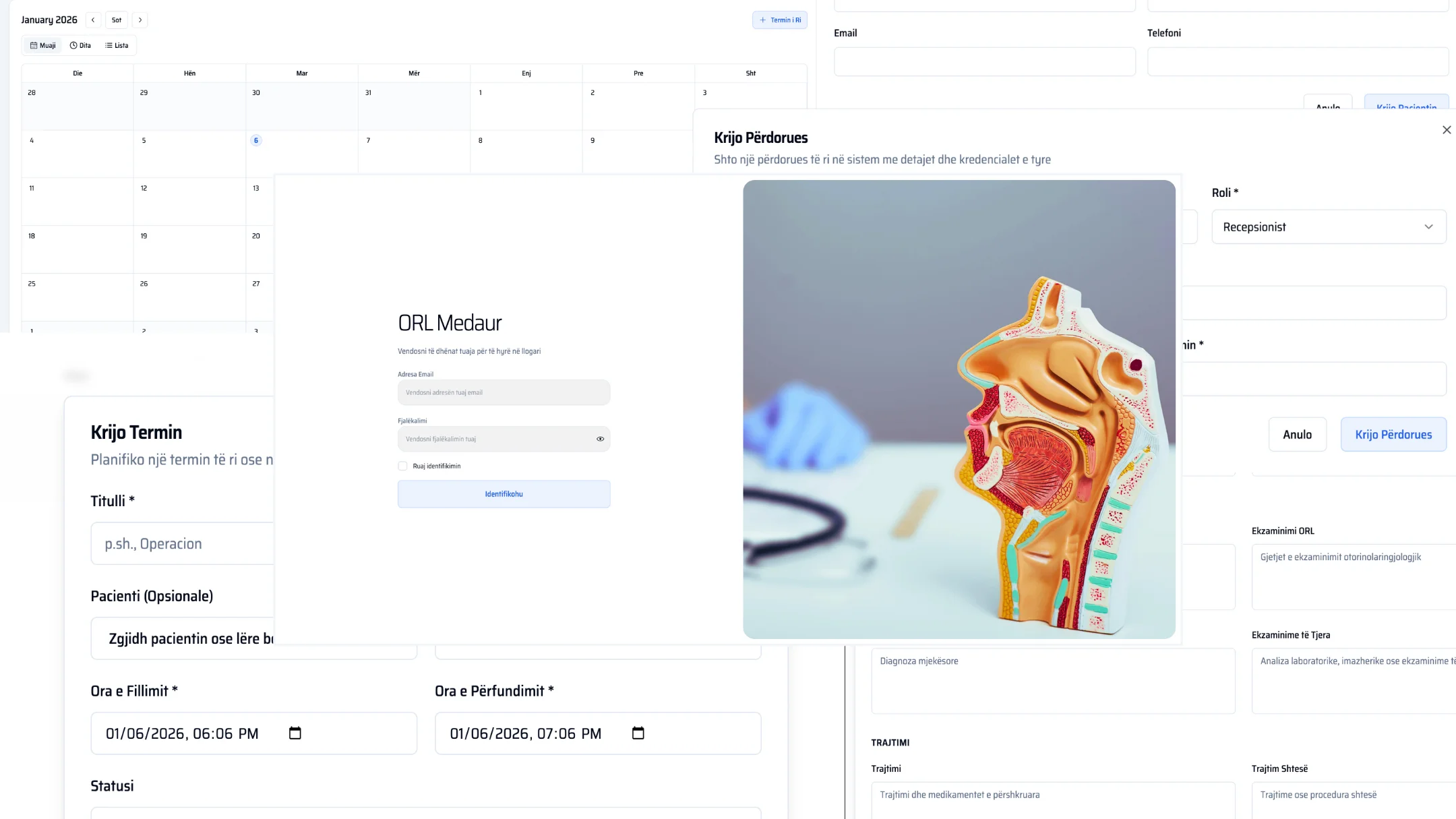
The Challenge
ORL Medaur's patient data was scattered across dozens of Excel files, creating a nightmare for medical staff. The biggest pain point: when patients returned for follow-up visits, they were entered as entirely new records rather than linked to their existing history. A patient who visited in 2007, 2015, and 2024 existed as three separate entries with no connection between them. Doctors had no unified view of a patient's medical journey—they couldn't see previous diagnoses, treatments, or notes without manually searching through multiple spreadsheets. Appointments were tracked on paper calendars, data entry took excessive time, and the entire system was fragile, unsearchable, and prone to human error.
My Role
I handled all design and frontend development for this project, collaborating with a backend team handling the Django REST Framework API. I was responsible for the complete UI/UX design system, all frontend development using TypeScript, and full API integration to connect the interface with the backend. From wireframes to production code, I owned the entire user-facing experience.
The Approach
My core strategy was radical simplification for non-technical medical staff who have zero tolerance for learning curves. Healthcare workers need to focus on patients, not software—so the system had to be immediately intuitive. I designed every interaction to require minimal clicks, used familiar medical workflows as the structure, and prioritized visual clarity over feature density. The goal was to build something that feels like it's helping, not something that needs to be "figured out."
